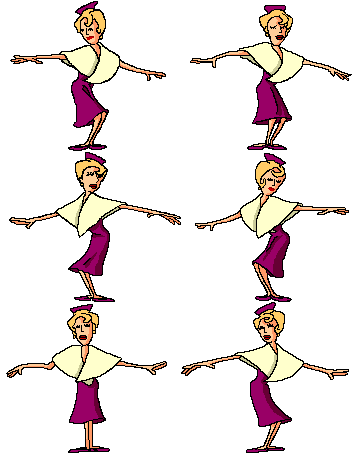
A take on life pre- during and post-hysterectomy. A funny take. I think it’s funny, anyway – doing it kept me entertained when I wasn’t allowed to do anything beyond lazing about in enormous knickers and, occasionally, a lovely dress. (Turn your speakers on for the funky tune.)
Tagged: sex

Sep 15
Pathologising Passion
 Did you know that wearing socks in bed may improve your sex life? It’s true: in a study, 80% of people wearing socks came, compared to 50% of those with no socks on. Brain scans carried out during sex (there were no diagrams so I’m a bit hazy on the details of how, exactly) showed that different areas of the brain are active in men and women during sex: in male brains, emotion centres are deactivated and the focus is on sensations transmitted from the genitals to the brain; in female brains, the response is more complex, combining emotions, physical sensation and the relaxation of brain areas processing anxiety and fear. The more hyaluronic acid a person has in their face, the more attractive they appear. After a break-up, brain scans show that the same parts of the brain light up when someone is shown a picture of their ex and thinks about time they spent together as when they experience physical pain by having a hot probe touch their arm. A study during which men watched porn with a device attached to their penis that measured arousal, showed that homophobic men are most sexually aroused by gay male porn. 60% of normal people have ongoing “sexual desire” problems and 80% of women say they make their loudest ohs and ahs when they’re not enjoying sex and want their man to hurry up and come so it’ll be over with. Exploring your date’s “Sociosexual Orientation” (i.e. why they have sex) can help you decide if there should be a second date or you’re likely to be fatally incompatible in bed.
I know all these things because I read about them in scientific studies which, of course, means they must be true. They’re quite interesting in an anecdotal sort of way, but I don’t really see why the studies are necessary or quite what the point of them is. Scientists have their say about every single aspect of our lives, from what we eat and how much exercise we do to how much sleep we need and how many compartments there should be in our recycling bin. Now they’re dissecting sex by attaching devices to penises that measure girth (increased girth being a sign a man’s turned on) and immobilising people’s heads in CAT scans so they can see which bits of their brains light up most during sex. I admire people who take part in these studies because I’ve no idea how anyone could get turned on immobilised in a room full of labcoats, but the results are hardly likely to be reflective of people who aren’t under scientific scrutiny. Who’s to know what’s going on in the brains of people who are just frolicking in their bedroom? It could be that, left alone, people’s brains light up all over the place – not just in localised spots that indicate men feel no emotion during sex while women experience a gamut of them. Tying desire to evolution already took half the romance out of it and now we’re supposed to have sociosexual orientations that determine why we have sex, none of which allows for just fancying the pants off someone, and a barrage of statistics telling use what, why, how and where we’re doing it. We can’t even keep our socks on without there being some scientific reason for it – it’s got to be because, if I wear socks, I’m 1.6 times more likely to come than if I’ve got bare feet. These statistics and percentages serve no purpose, aside from the faint possibility they might make one of the 80% of women faking it in deafening tones feel a bit better because she knows she’s not the only one having crap sex. I don’t think there’s a place for science in the bedroom (or wherever your sociosexual orientation dictates you like having sex). It’s one of the few places where we aren’t likely to run into science and all its predictions/explanations/investigations – unless, of course, you’re sleeping with a scientist in which case, frankly, it’s your own fault. As far as I’m concerned, it’s my bedroom and I’ll keep my socks on if I want to – or not, if I’m willing to risk a 37.5% drop in the likelihood I’ll come.
0
comments
Aug 28
The Revenge of The Bunny
 Debunking of the Playboy myth began in 1963 when Gloria Steinem went undercover as a Bunny at the New York Playboy Club and revealed the ill-treatment behind the glamour in “I Was A Playboy Bunny”.
Still, the lure of Hef in his silk pyjamas, the man who says his best pick-up line is “Hi, I’m Hugh Hefner”, continues to enthral. 48 years after Steinem’s exposé, over 3000 women auditioned for positions as Bunnies in the London Playboy Club, almost half a century of feminism having apparently passed them by, so they could go to work in a leotard, rabbit ears, bowtie and pom-pom. Women send him pictures of their naked bodies to appraise, in the hope he’ll make them Playmate of the Month, some having invested heavily in plastic surgery in the hope it will increase their appeal. Anyone in his employ with a complaint about working conditions or the boss has tended to keep shtoom.
Then the High Priestesses of Bunniedom, Hef’s girlfriends, started ditching him and writing tell-all accounts of life inside the Playboy Mansion. Jill Ann Spaulding’s Upstairs and Izabella St. James’ Bunny Tales: Behind the Closed Doors of the Playboy Mansion bear no relation to the glamour and liberalism with which Hefner has so desperately tried to associate himself. Instead, they talk of dog shit encrusted carpets, curfews, unprotected sex, Hef’s miserliness, quaaludes given to Hef’s favourites en route to night clubs where they were allowed to do nothing but fawn over him, bitching and boredom. Hef’s twice-weekly “sex parties” the women have to attend – unless they’ve recently had surgery, in which case they’re excused – consist of each woman sitting on his condomless viagra-hardon for two minutes while the others cheer “fuck her daddy” and play at being lesbians to keep him turned on. If they don’t want to have sex with him, they keep their pink pyjama bottoms on, but repeatedly doing so tends to result in the woman being asked to leave the mansion. St. James’ book is billed as a “steamy tell-all”, but, based on the content, I don’t think that’s quite how she intended it to be perceived. Unless stepping in dog shit while queuing for your weekly allowance and faking lust for the “dead fish” that was Hef in bed, do something for you, I don’t see that it would steam up anything.
I don’t really have a cogent argument against The Playboy Mansion, per se – though I have many against what Playboy itself represents as a brand, concept, and perpetuator of damaging cultural attitudes. I just don’t get the appeal of The Hefster – like piccalli, Tom Cruise, and vampires.
2
comments
Jul 28
Exposing Phallacy Excerpts
Whatever you think about flashing – nothing at all, mildly curious, or think of nothing but – here are some excerpts from my book on the subject, Exposing Phallacy – Slick Slits and Throbbing Clits, The Penis and Masculinity and The Demise of the Good Old-Fashioned Roll in the Hay. Enjoy. Or possibly not.

0
comments
Jul 13
In praise of the lady gadabout
 Unkempt, unruly, bad-mannered, and lascivious, the blowsy woman has long been dismissed for her sluttish ways and refusal to behave nicely. Originating from the 18th century blowze, the word blowsy has been used to malign a woman as a beggar, wench, and – of lower social ranking to the beggar himself – a beggar’s female companion. I think it’s time her virtues were re-evaluated.
What a blowsy woman really is, is a woman of appetites – for food, drink, sex, and all that life can offer. She’s not perpetually mid-diet, turning down dessert and pounding her joints on a treadmill to burn off the few calories that may have slipped in somewhere between the no-fat-gluten-free muffin and the salad, sans dressing. Her drinking is not a glass of wine with lunch and her love affairs are not discrete. Nor are they with her husband. But the real problem in all of this – the thing that has brought her so much suspicion and derision – is that she doesn’t care. She doesn’t have time to be forever presentable and polite. Her waywardness is too time-consuming and, frankly, too much fun. Who can be bothered with etiquette and preserving your looks when your lustiness might take you somewhere far more exciting? read on
1
comments
Jul 02
Whatever happened to the good old-fashioned roll in the hay?
 Sexuality is, to put it mildly, a convoluted subject. From a process of reproduction, sex has become something of labyrinthine complexity. It is far more than just our sex organs. Whether we’re aware of it or want to, we bring to sex our pasts, desires, preconceptions, prejudices, morals, insecurities, and emotions. There are expectations of both men and women – everyone wants to be thought of as good in bed, but what that involves has become increasingly demanding. We’re all to be porn stars. Girls as young as eleven are pressured by their peers (their female friends as much as the boys) into replicating the sex their boyfriends have seen in porn. Admit you like the missionary position and you might as well declare yourself a Puritan and get thee to a nunnery. No, we’re all supposed to be as limber as a Cirque du Soleil contortionist. Sex isn’t just a fun way to spend the afternoon, it’s a competition. We try to be better than the last lover – or, indeed, anyone the other person has ever had sex with. Sex is to be mind-blowing, ne’er before known heights of ecstasy, unforgettable and impossible to surpass. We count our orgasms, rating our lovers by the number of times they make us come in a night. Even if we wouldn’t want to venture into the world of slings and hardcore S&M, we’re blasé about the more extreme sexual practices because that’s the fashionable way to be. We buy into the highly lucrative concept that our sex lives need to be spiced up – thrilling at all times. At the mellow end of the market are scented candles and a romantic dinner; role play and dressing up usually make the list; then there’s a little light bondage of the Ann Summers handcuffs and whipped cream variety; and sex manuals are a must, though nothing of the boring old Joy of Sex sort – they have to be fun fun fun. On and on it goes in the quest for the perfect shag.
No matter how modern all this might make us feel, there remains the double standard between men and women regarding sexual mores. There are no derogatory words for a promiscuous man, but innumerable ones for a woman. How many men a woman has sex with and how soon after meeting shouldn’t be worth even mentioning, but it is the subject of countless, and constant, debates. Living by The Rules or by one’s own ought to be a given, but women frequently lie about the number of lovers they’ve had and the extent of their experience, downplaying both to their partners. I don’t think anyone quite knows why we do this, why we have such contrasting views of male and female behaviour, but it’s a practice that every generation adopts, to a greater or lesser extent, and has done so over centuries. Porn encourages us to act like a slut in the bedroom, but apparently we’re not supposed to actually be one out of it.
I’m not arguing in favour of mediocre sex. No one wants that. I don’t think men should, à la Christian missionaries, pray for god’s forgiveness for taking carnal pleasure and their wives’ bodies be concealed by full-length white nightdresses with a hole embroidered in the shape of a cross over their vaginas. Sex is supposed to be fun. It’s supposed to be about people – real life ones, not the ones pornography, magazines, adverts, and billboards tell us we should be. The anal sex her boyfriend saw onscreen shouldn’t be a part of an 11-year-old girl’s life. Her life should be about her – what she wants to do and what she enjoys – not what porn told her boyfriend she ought to be. You’d think we’d grow out of that, but the idea that sex is a performance to impress our lover surrounds us and, inevitably, affects the way we view ourselves and those with whom we have sex. In attempting to emulate the moves of a porn star, women are understudying to others paid to fake orgasms and pleasure. Role play is one thing, but if women are faking it, in whole or in part, all to seem like the person they believe their lovers want them to be, then it begs the question of who everyone is sleeping with – the person we know or the one they’re pretending to be for our benefit because that’s what they believe we want and, possibly, what we’ve come to believe we want, too. It’s no wonder we’re confused.
5
comments